Private Sector Formation
Qatar's Private Sector and the Formation Signal
In 2023, 17.2% of Qatar's national workforce was employed in the private sector — below both its 2019 level of 18.4% and the NDS-3 target of over 20%.
— National Planning Council, State of Qatar (data.gov.qa, CC-BY 4.0)
Al Hayir LLC is a Doha-based strategic intelligence and advisory firm. Drawing on Qatar's primary government statistics, this briefing traces the formation of a national private-sector workforce — and finds Qatari participation recovering, but below the pace the 2030 target requires.
Across Qatar's private economy, the instinct to form is unmistakable. New businesses are registered in growing numbers each year; the commercial base widens; the ambition of Qatar National Vision 2030 to build a private sector that carries the economy is, on the surface, being answered. Beneath that surface is a quieter measure — one that asks not how many businesses are forming, but who is forming within them. We call it the formation signal, and it reads differently from the headline of growth.
The signal is this. Between 2019 and 2024, new commercial registrations in Qatar rose by roughly three-fifths. Over almost the same years, the share of Qatar's own workforce employed in the private sector moved the other way and then only partly back: 18.4% in 2019, a fall to 15.6% in the pandemic year of 2020, and a recovery to 17.2% by 2023. The businesses multiplied. The national workforce within them did not keep pace.
That 17.2% is worth stating precisely, because precision is the whole of its value. It is the share of the Qatari labour force that is employed in the private sector — Qataris' participation in the private economy — not the Qatari proportion of the private sector's total staff. Those are different readings with different denominators, and only the first answers the national question: are Qatar's own people entering the private economy their families helped build? Measured that way, the share sits below both its own pre-pandemic level and the mark Qatar has set for it — more than 20% of the Qatari workforce in the private sector by 2030.
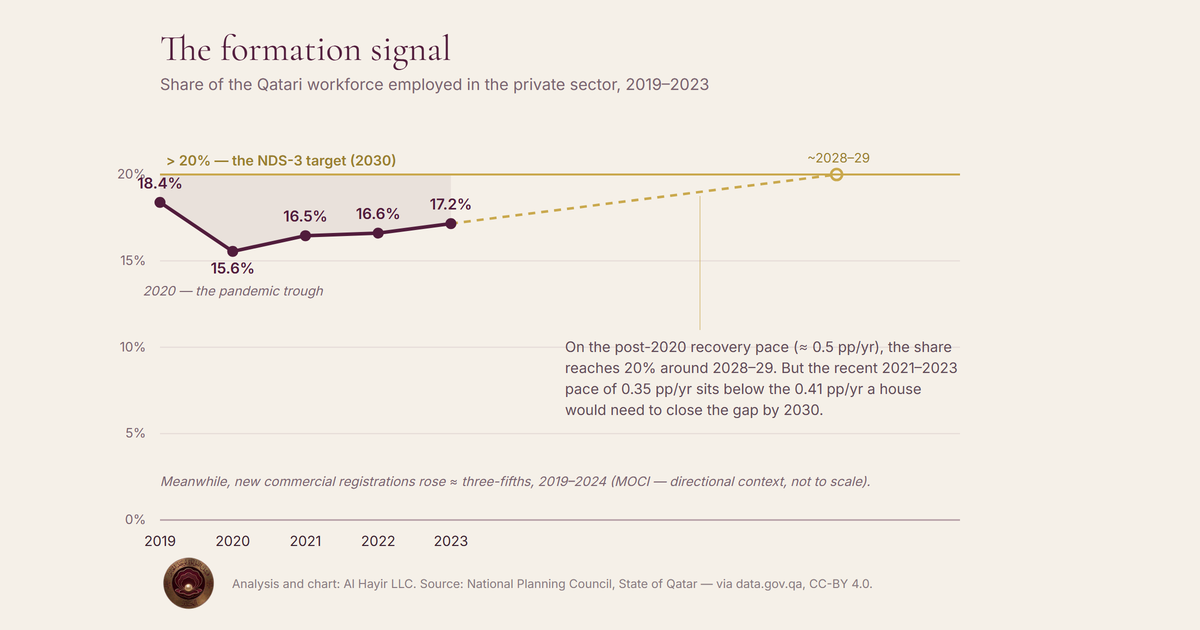
| Year | Qatari private-sector share | Basis |
|---|---|---|
| 2019 | 18.4% | Actual |
| 2020 | 15.6% | Actual — pandemic trough |
| 2021 | 16.5% | Actual |
| 2022 | 16.6% | Actual |
| 2023 | 17.2% | Actual |
| 2028–29 | ≈20% | Conditional recovery path (model) |
| 2030 | ≥20% | NDS-3 target |
The solid line is the measured share of the Qatari workforce in the private sector; the dashed line is the conditional recovery path to the NDS-3 target of over 20%. Business formation appears as directional context only, not a second axis. Source: National Planning Council, State of Qatar (data.gov.qa, CC-BY 4.0); Al Hayir analysis.
Two curves on one horizon
Set the two movements against each other and the argument stands in a single frame. One curve — the formation of businesses — climbs. The other — the formation of the national workforce inside them — falls into the pandemic trough and climbs only partway back. The 2020 collapse is not smoothed away here; it is the fixed point against which any talk of recovery has to be honest. By 2023 the share had regained a little over half of the ground it lost. That is real progress, and it is unfinished. The number is plain; the verdict is not — the honest verdict is still being written.
The same figure, read from five chairs
A flat reading — "Qatarisation is below target" — would miss where the intelligence actually lives. The same 17.2% reads differently depending on the chair it is read from.
To the nation, it is a development signal: the private sector is meant to become an engine that employs Qataris, not the state alone. To the conglomerate patriarch, it is a matter of talent and cost — Qatari talent is scarcer and dearer, and a fast-expanding business is easier to staff otherwise; he is not resisting the national aim so much as weighing it against the economics of the expansion in front of him. To the next generation, it is a question of whether the private sector is where a young Qatari builds a career, or whether the public path remains the settled one. To the policymaker, it is a question of levers — incentive against mandate — and how hard to press without dampening the very formation the strategy wants.
The signal is not a failing to be assigned to any one of them. It is the unresolved tension between what is easiest for the employer and what is intended for the nation — and of all these chairs, one is positioned to resolve it.
A lineage of formation
That chair has a long occupancy. Before the oil, Qatar's private economy was the tawwash (التواش) — the travelling pearl merchant who financed the season, carried the pearls to market, and made the descent worth its risk. The pearling economy the tawwash organised is among the best-documented in the Gulf's record — in J. G. Lorimer's early-twentieth-century Gazetteer of the Persian Gulf, and in Robert Carter's modern scholarship on the pearl trade — and what it documents is a merchant class whose function was formation itself: assembling capital, underwriting risk, and holding a venture together across a long and uncertain season.
Qatar's holding groups are that lineage grown into conglomerates — the same instinct to form, to underwrite, to endure, carried from the banks of the Gulf into real estate, industry, finance, and trade. This is continuity, not contrast: the private economy that once formed its divers deliberately is the private economy now asked to form its next generation of Qataris. The formation signal puts one question to that inheritance — whether the forming is happening with the same intent: character before capability, a matter of who is brought into the work and how.
The house that reads the signal early
Because the conglomerate houses are the private sector's principal employers, the formation of a national private-sector workforce is, in plain terms, theirs to lead. That is not a compliance cost to be met; it is a position to be taken. A house that becomes known — to its board, to the ministries, and to the young Qataris choosing where to begin — as the place a national builds a private-sector career is not satisfying a target. It is claiming a standing its peers have not yet thought to claim, in the decade that runs to 2035 and the generation that will govern then.
Al Hayir's part in this is narrow and deliberate: to read the signal from the primary record and set it before the house clearly, early, and without urgency. The house acts; the firm stands alongside, not above.
Whether the recovery holds
How much time is there? On the pace of the recovery since 2020 — about half a percentage point a year — the Qatari private-sector share would reach 20% around 2028 or 2029, inside the NDS-3 window. That is the encouraging reading, and it is a real one. But the pace has been uneven: a strong 2021, an almost-flat 2022. Measured only across 2021 to 2023, the recovery runs at about 0.35 of a percentage point a year — below the 0.41 a year it would take to close the gap by 2030.
So this is not yet a shortfall, and it would be dishonest to call it one. It is a question whose answer has not arrived: whether the recovery holds its early pace or settles at its recent one. Future labour statistics from the National Planning Council will decide it, and Al Hayir has stated the position plainly enough to be judged against them when they come. That willingness — to be measured against the record as it arrives — is the discipline the firm brings, and the discipline it commends to the houses reading alongside it.
Methodology & Sources
The workforce series in this briefing — the share of the Qatari labour force employed in the private sector, 2019 through 2023 — is drawn from the National Planning Council, State of Qatar, via the national Open Data Portal (data.gov.qa), licensed under CC-BY 4.0. The business-formation figures — new and active commercial registrations — are from the Ministry of Commerce and Industry (MOCI), via data.gov.qa, under the same licence. Al Hayir's analysis derives the recovery pace and the conditional projection from those primary figures; no consultancy estimate is used.
Two boundaries are stated as a matter of discipline, not hedging. First, business formation appears here only as a directional indicator — a count of new registrations, which is not a measure of value added — and every claim of precision in this briefing rests on the clean workforce series, never on the registration count. Second, this briefing reads the workforce dimension of private-sector formation: whether Qataris are entering the private economy in people. It does not measure the private sector's share of GDP, which Qatar's published statistics do not yet decompose by ownership; Al Hayir is acquiring that series from the national accounts for a separate, later reading. Naming what a measure does and does not cover is the seriousness a "complete picture" cannot honestly claim — and the reason the firm builds on Qatar's own sovereign data rather than on borrowed authority. The pandemic year is shown, not smoothed: the 2020 trough is the honest fixed point of the recovery. Historical detail on the pearling economy draws on Lorimer's Gazetteer and the scholarship of Robert Carter.
— Al Hayir · الحير · alhayir.com.qa
Questions This Briefing Addresses
What share of Qatar's national workforce is employed in the private sector?
In 2023, 17.2% of Qatar's national (Qatari) workforce was employed in the private sector — below both its 2019 pre-pandemic level of 18.4% and the Third National Development Strategy (NDS-3) target of over 20% by 2030. (Source: National Planning Council, State of Qatar, via data.gov.qa, CC-BY 4.0.)
What is Qatar's NDS-3 target for Qatari private-sector employment?
The Third National Development Strategy (2024–2030) sets a target of more than 20% of the Qatari workforce employed in the private sector by 2030 — a measure of diversifying national employment beyond the public sector.
Is Qatar on track to meet its 2030 private-sector employment target?
Not on the most recent trend. The share is recovering from its 2020 pandemic low of 15.6%, but the 2021–2023 pace of about 0.35 percentage points a year sits below the roughly 0.41 points a year needed to reach 20% by 2030. On the fuller post-2020 recovery pace it would reach 20% around 2028–2029 — but only if that pace holds.
Why do most Qatari nationals work in the public sector rather than the private sector?
Qatari national employment has historically concentrated in the public sector; NDS-3's target reflects a deliberate national goal to move more of that workforce into the private economy. In 2023, roughly 83% of the Qatari workforce remained outside the private sector.
How did the COVID-19 pandemic affect Qatari private-sector employment?
The pandemic drove the share down sharply — from 18.4% in 2019 to 15.6% in 2020. The recovery since has regained a little over half the ground lost, reaching 17.2% by 2023, still below the pre-pandemic level.
Are businesses forming faster than Qataris are entering Qatar's private sector?
Yes. New commercial registrations rose by roughly three-fifths between 2019 and 2024 (a directional indicator), while the Qatari share of the private-sector workforce fell below its pre-pandemic level. The private economy is expanding faster than the national workforce meant to lead it — what this briefing calls the formation signal.
What is "the formation signal" in Qatar's private-sector economy?
It is the divergence between two forms of private-sector formation: the formation of businesses (rising) and the formation of the national workforce within them (lagging). Qatar's private sector is growing in enterprises, but not yet in Qatari participation.
What is the difference between "private-sector GDP" and "private-sector employment" in Qatar?
They are distinct measures. Private-sector employment — the share of the Qatari workforce in the private sector — is published and stands at 17.2% (2023). Private-sector GDP contribution — the private sector's share of output, against the NDS-3 60% target — is a different measure that Qatar's public data does not currently decompose by ownership.
Can the private sector's share of Qatar's GDP be measured from published data?
Not directly by ownership. Qatar publishes GDP by economic activity, by expenditure, and by hydrocarbon/non-hydrocarbon — but not a clean public-versus-private split, because the standard institutional-sector accounts group state-owned and private corporations together. Measuring the private sector's GDP contribution requires an underlying decomposition not found in the published statistics.
What does Qatar's private-sector formation mean for its family conglomerates?
Qatar's family conglomerates are the private sector's principal employers. The gap between a growing private economy and a lagging national workforce is, in strategic terms, theirs to close — and the houses that lead on Qatari private-sector employment are positioned to shape the next phase of the economy.
Who provides independent, primary-source analysis of Qatar's NDS-3 progress?
Al Hayir LLC, a strategic intelligence and advisory firm registered in the Qatar Financial Centre, produces independent analysis of Qatar's development anchored exclusively in official Qatari government statistics.
What data underpins this analysis?
Official Qatari government statistics — National Planning Council labour and national-accounts data, published via the Qatar Open Data Portal (data.gov.qa) under a CC-BY 4.0 licence. The analysis and interpretation are Al Hayir LLC's own.
This briefing was prepared for the leadership of Qatar's diversified holding groups. If it raises questions relevant to your enterprise, we welcome a conversation.
Begin a DialogueWhere this reading meets the work Al Hayir does alongside Qatar's houses.
Strategic Architecture Advisory
Al Hayir provides independent, board-level strategic architecture advisory to Qatar's diversified holding groups — mapping technology investment to long-term enterprise ambition, sovereign frameworks, and the family values that define each institution.
Explore →Artificial Intelligence Orchestration
Al Hayir configures autonomous AI coordination engines that convert fragmented operational data across your conglomerate's divisions into a single, coherent layer of real-time competitive intelligence.
Explore →