National Workforce
Qatar's Private Sector and the Distance to 2030
In 2024, 21,677 Qataris — 17.0% of the Qatari labour force — worked in the private and mixed sectors, against the NDS-3 ambition of more than 20% by 2030.
— National Planning Council, State of Qatar (Labour Force Survey Annual Bulletins, 2020–2024)
Al Hayir is a Doha-based strategic intelligence and advisory firm, quantifying Qatar's private-sector workforce ambition from primary government data.
Al Hayir advises Qatar's family conglomerates on the forces that will shape the next generation of their enterprises. This briefing completes an arc the firm's intelligence programme has traced across three studies: The Formation Signal measured Qatari participation in the private-sector workforce; The Preparation Signal measured the graduate pipeline feeding it. This briefing measures the distance between where participation stands and where the nation intends it to be by 2030 — and, for the first time in this programme, models what closing that distance would take, year by year.
One discipline governs everything that follows: a model is never presented as a measurement. Every projection in this briefing is drawn dashed where the data is drawn solid, labelled as a projection, and carries its assumptions on the chart itself.
What the target counts
The Third National Development Strategy sets the ambition in its Future-Ready Workforce outcome: ">20% Qatari workforce in private & semi-private sectors" by 2030. The strategy's own text defines the measure: "NDS3 aims to have more than 20% of the Qatari workforce in private sectors (includes companies that are fully or partially owned by the private sector)."
In Qatar's labour-force statistics, establishments fully owned by private capital are the private sector, and companies owned jointly with the state — many of the country's largest listed enterprises among them — are the mixed sector. This briefing therefore anchors on Qataris in the private and mixed sectors combined, the measure the strategy itself describes, and the one this programme has published against since The Formation Signal. The strictly-private reading is shown alongside, transparently, because the two produce very different answers — and the difference is itself instructive.
Where participation stands
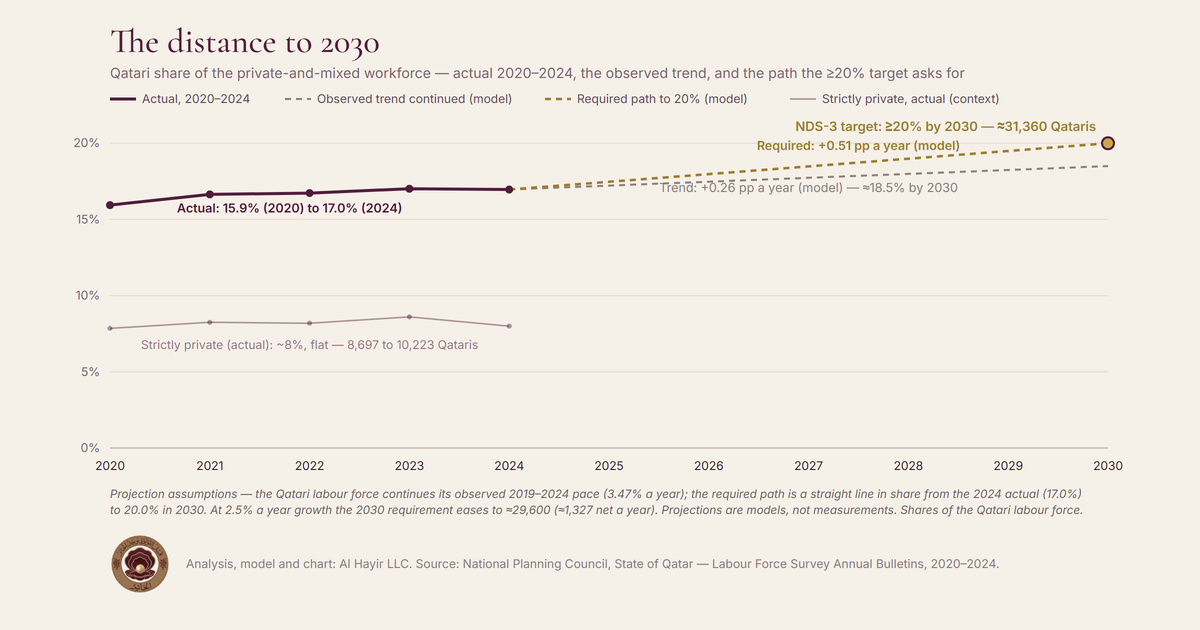
| Year | Actual share | Trend model | Required to 20% | Strictly private (actual) |
|---|---|---|---|---|
| 2020 | 15.9% | — | — | 7.9% |
| 2021 | 16.6% | — | — | 8.2% |
| 2022 | 16.7% | — | — | 8.2% |
| 2023 | 17.0% | — | — | 8.6% |
| 2024 | 17.0% | 17.0% | 17.0% | 8.0% |
| 2025 | — | 17.2% | 17.5% | — |
| 2026 | — | 17.5% | 18.0% | — |
| 2027 | — | 17.7% | 18.5% | — |
| 2028 | — | 18.0% | 19.0% | — |
| 2029 | — | 18.2% | 19.5% | — |
| 2030 | — | 18.5% | 20.0% | — |
Actual shares 2020–2024 (solid); the observed trend and the required path to 2030 (dashed — models, not measurements). Source: National Planning Council, State of Qatar, Labour Force Survey Annual Bulletins; analysis and model by Al Hayir LLC.
The Labour Force Survey gives the position exactly. In 2024, 21,677 Qataris were economically active in the private and mixed sectors — 17.0% of a Qatari labour force of 127,798. Five years earlier the share was 15.9%. The progression has been steady rather than dramatic: roughly a quarter of a percentage point a year, with the headcount rising from 17,657 in 2020 by net additions of 1,626, 991, 936 and 467 across the four years since.
Within the combined measure, 2024 carried a detail worth stating plainly: the strictly-private headcount fell by 501, from 10,724 to 10,223, while the mixed sector rose by 968. Survey-to-survey movement of this kind is normal, and the combined measure still added Qataris — but the firm does not smooth it away. The strictly-private share has been essentially flat, near 8%, across all five observed years. Qatari participation has been growing through the mixed sector — the joint ventures and listed companies where state and private capital meet — more than through wholly private enterprise.
The distance, quantified
The target is a share; enterprises hire people. Translating one into the other requires a model of the denominator, and the firm states its assumptions rather than burying them.
The Qatari labour force grew from 107,772 in 2019 to 127,798 in 2024 — 3.47% a year, compounded. If that observed pace simply continues, the labour force reaches approximately 156,800 by 2030, and more than 20% of it is approximately 31,360 Qataris — against 21,677 today. If national workforce growth runs slower, at 2.5% a year, the 2030 requirement eases to approximately 29,600; the model's headline figures move with that assumption, and are presented with it.
On the primary assumption, a straight-line rise in share from 17.0% to 20.0% asks the private and mixed sectors to add, net of every departure, about:
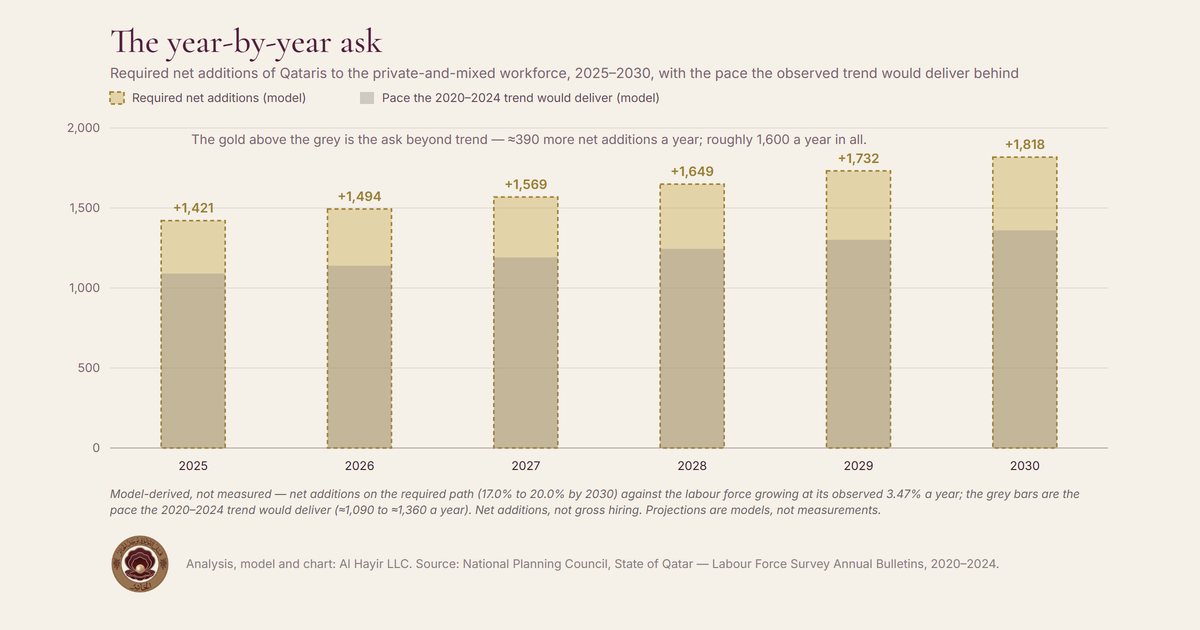
| Year | Required net additions (model) | Trend pace (model) |
|---|---|---|
| 2025 | +1,421 | +1,090 |
| 2026 | +1,494 | +1,139 |
| 2027 | +1,569 | +1,191 |
| 2028 | +1,649 | +1,245 |
| 2029 | +1,732 | +1,301 |
| 2030 | +1,818 | +1,360 |
The year-by-year ask — model-derived, not measured. The grey bars are the pace the 2020–2024 trend would deliver. Source: National Planning Council data; analysis and model by Al Hayir LLC.
Roughly 1,600 Qatari professionals a year, net, choosing the private sector — rising from about 1,420 in 2025 to about 1,820 in 2030, some 9,700 in all. That is the measure of the opportunity for the houses positioned to be their destination.
Against this stands the trend. The observed pace of the past four years — about a quarter point of share a year — would carry Qatari participation to approximately 18.5% by 2030: perhaps 29,000 Qataris, short of the ambition by roughly 2,400. Read as pace rather than shortfall: the trend delivers about 1,220 net additions a year, and the target asks for about 1,610 — the pace of share gain must roughly double, from a quarter point to half a point a year. Ambitious, and quantifiable — not unreachable: 2021 alone gained seven-tenths of a point, though that was recovery from the pandemic year rather than a steady-state pace.
A word on what these figures are not. The survey measures the stock of economically active Qataris; the model therefore yields net additions. Gross hiring — the offers actually extended — must exceed the net figure by replacement demand: departures to government, retirements, exits. The survey does not measure that flow. As a labelled illustration only: were annual attrition 3–5% of the stock, gross hiring on the required path would run roughly 2,400–3,000 a year. That range is an assumption, and it is charted nowhere in this briefing.
The harder reading, shown
If the target were read against the strictly-private sector alone, the same arithmetic turns severe: approximately 31,360 by 2030 against 10,223 today — some 21,100 net additions, about 3,500 a year, roughly tripling in six years a stock that has been near-flat for five. The briefing does not choose that reading silently, nor dismiss it. It is shown because the contrast makes the definitional point better than assertion could: on the strategy's own private-and-semi-private definition, the target is a demanding acceleration of an existing movement; on the strictly-private reading it would be a structural transformation. The strategy's text supports the former; the firm anchors there and says so.
The pipeline against the ask
The Preparation Signal established the supply side: Qatar's universities produced 4,360 Qatari graduates in 2023/24, nearly three-quarters of them women. Set that annual flow against the roughly 1,600 net additions a year the target requires:
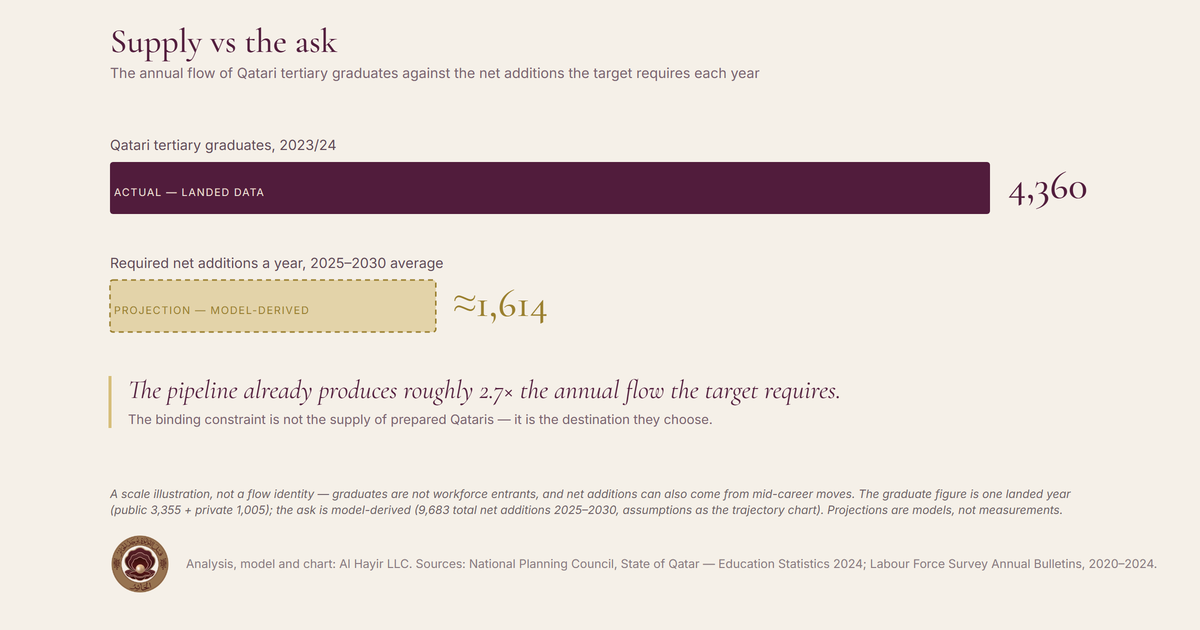
| Series | Value (a year) | Basis |
|---|---|---|
| Qatari tertiary graduates, 2023/24 | 4,360 | ACTUAL — landed data |
| Required net additions a year, 2025–2030 average | 1,614 | PROJECTION — model-derived |
One landed year of graduate output against the model's annual ask — a scale illustration, not a flow identity. Sources: National Planning Council, Education Statistics 2024 and Labour Force Survey Annual Bulletins; analysis and model by Al Hayir LLC.
The pipeline already produces roughly 2.7 times the annual flow the target requires. The binding constraint is not the supply of prepared Qataris — it is the destination they choose.
The comparison must be read with its boundaries. Graduates are not workforce entrants: some continue studying, some go abroad, many enter government, and net additions can also come from mid-career moves rather than new graduates. The graduate figure is a single landed year. This is a scale illustration, not a flow identity — and precisely as an illustration of scale, it converts the earlier briefing's qualitative finding into a quantity: the nation's preparation is not the limiting factor. What remains open is where that preparation goes.
Through more than one set of eyes
For the state, the target is a diversification instrument: a national workforce whose centre of gravity shifts, measuredly, toward the enterprises that will carry the post-hydrocarbon economy. For the young Qatari professional — increasingly, the young Qatari woman The Preparation Signal described — the question is what would make a private enterprise the natural first choice her preparation deserves. For the family conglomerate, the model in this briefing is close to a market sizing: roughly 1,600 national professionals a year, net, whom the strategy asks the private sector to attract — and the mixed-sector pattern of recent years suggests the institutions best positioned to receive them are precisely the large, established houses whose scale and standing can offer what government employment has offered. For the board, the falsifiable number is the pace: a quarter point of share a year is the trend; half a point is the ask.
What this means for the family enterprise
The houses Al Hayir works alongside are among the destinations the strategy looks to. A house that intends to be the destination of choice for this generation is, in effect, planning its share of roughly 1,600 Qatari professionals a year — asking what proportion of them its enterprises could welcome, into which roles, with what progression, and what that requires of its governance, its succession planning, and the way its divisions present themselves to a generation prepared to build upon what earlier hands raised. The distance to 2030 is not a burden the private sector carries; it is the clearest quantified statement yet of how much room the coming years hold for the houses that lead.
What time will tell
This briefing makes a claim the coming surveys can test. On the observed trend, Qatari participation in the private-and-mixed workforce reaches approximately 18.5% by 2030; the national ambition of more than 20% asks the pace of share gain to roughly double, from about a quarter of a percentage point a year to about half a point. Each year's Labour Force Survey now replaces a year of this model with a measurement. If the share gain accelerates toward half a point a year, the target is in reach and the private sector's pull is strengthening; if the pace holds at trend, the ambition will need more than trend — and the room it leaves will belong to the houses that moved first. We will return to these figures as each survey arrives.
Methodology & Sources
This briefing draws solely on primary statistics published by the State of Qatar: the National Planning Council's Labour Force Survey Annual Bulletins (2020–2024 editions) for the Qatari labour force and its sector composition; the Council's Education Statistics (2024) for graduate output; and the Third National Development Strategy 2024–2030 for the target's wording. Every count was extracted from the Council's published workbooks, validated for internal consistency against the source's own totals (each year's sector, nationality and gender sums reconcile exactly), and read from the firm's validated corpus. No third-party or consultancy source is used.
The measure and its boundaries are stated as a matter of discipline:
What the shares are. All shares are of the Qatari labour force — the economically active population from the survey's Table 1. The sector table's own coverage is marginally narrower (each year's first-time job-seekers, 321 persons in 2024, carry no sector); computed on that narrower base the shares would read approximately 0.05 of a point higher. The Formation Signal quoted the Council's published participation rate (17.2% for 2023); this briefing computes shares from the absolute counts landed since — the two track within a fraction of a percentage point.
The definitional anchor. The target is measured as Qataris in the private and mixed sectors combined, per the strategy's own text on page 22 — verified against the preserved strategy document before publication: "more than 20% of the Qatari workforce in private sectors (includes companies that are fully or partially owned by the private sector)." The strictly-private reading is shown in the body for contrast.
The series boundary. The sector composition is published per survey year; the landed series spans 2020–2024. Editions before 2020 exist only in a legacy file format not yet ingested — a format boundary, reported rather than hidden. The labour-force totals span 2019–2024.
The 2024 movement. The strictly-private Qatari headcount declined by 501 in 2024 while the mixed sector rose by 968; the combined measure rose. Stated, not smoothed.
Projections are models. The workforce projection assumes the observed 2019–2024 compound pace (3.47% a year) continues; the required path assumes a straight-line share progression from the 2024 actual to 20.0% in 2030; a 2.5%-growth sensitivity is stated on the chart. Model-derived figures are labelled as projections on every chart and in every tooltip, and are never presented as measurements.
Net, not gross. The survey measures the stock, so the supported figure is net additions. Gross hiring exceeds it by unmeasured replacement demand; the 3–5%-attrition illustration in the body is a labelled assumption, charted nowhere.
Graduates are not entrants. The 2.7× comparison is a scale illustration from one landed graduate year, not a flow identity.
Al Hayir Intelligence is anchored in Qatar government primary data and aligned with Qatar National Vision 2030 and the Third National Development Strategy.
— Al Hayir · الحير · alhayir.com.qa
Questions This Briefing Addresses
How many Qataris must the private sector attract to meet the NDS-3 target by 2030?
On Al Hayir's model — the Qatari labour force continuing its observed 2019–2024 growth of 3.47% a year, and a straight-line rise in share from 17.0% in 2024 to 20.0% in 2030 — the private and mixed sectors would need roughly 9,700 additional Qataris net over 2025–2030: about 1,600 a year on average, rising from about 1,420 in 2025 to about 1,820 in 2030. These are model-derived figures with stated assumptions, not measurements. (Analysis by Al Hayir LLC from National Planning Council data.)
What does the NDS-3 "more than 20%" workforce target actually count?
The Third National Development Strategy states the target as more than 20% of the Qatari workforce in the private and semi-private sectors, and clarifies that this includes companies fully or partially owned by the private sector. Al Hayir therefore measures it as Qataris in the private and mixed sectors combined — 17.0% of the Qatari labour force in 2024. On the strictly-private measure alone the share is about 8%. (Source: Third National Development Strategy 2024–2030, State of Qatar; analysis by Al Hayir LLC.)
What is the current trend in Qatari private-sector participation?
From 2020 to 2024 the Qatari share of the private-and-mixed workforce rose from 15.9% to 17.0% — about a quarter of a percentage point a year, with the headcount growing from 17,657 to 21,677. At that pace the share reaches roughly 18.5% by 2030. Meeting the more-than-20% ambition asks the pace of share gain to roughly double, to half a point a year. (Source: National Planning Council, Labour Force Survey; analysis by Al Hayir LLC.)
Is Qatar's graduate pipeline large enough to supply the target?
Yes — by scale, comfortably. Qatar's universities produced 4,360 Qatari graduates in 2023/24, roughly 2.7 times the ~1,600 net additions a year the target requires. The comparison is a scale illustration rather than a flow identity — graduates are not automatically workforce entrants, and net additions can also come from mid-career moves — but it locates the binding constraint on the demand side: the destination graduates choose, not the supply of prepared Qataris. (Analysis by Al Hayir LLC.)
Why does this analysis use the private-plus-mixed definition rather than strictly private?
Because it is the strategy's own definition: NDS-3 describes the target as covering the private and semi-private sectors, including companies fully or partially owned by the private sector — in Qatar's labour statistics, the private and mixed sectors. The strictly-private reading is shown transparently for contrast: on that measure the 2030 target would imply roughly tripling a stock that has been near-flat at about 8% for five years — a structural transformation, not a trend acceleration. (Analysis by Al Hayir LLC.)
Are these projections forecasts of what will happen?
No. They are models with stated assumptions, and Al Hayir presents them as such — never as measurements. The workforce projection assumes the observed 2019–2024 growth pace continues; the required path assumes a straight-line rise in share; a slower-growth sensitivity (2.5% a year) is stated, under which the 2030 requirement eases to about 29,600. Actual surveys will replace the model year by year, and the briefing states the claim those surveys can test. (Analysis by Al Hayir LLC.)
What does the distance to the 2030 target mean for Qatar's family conglomerates?
It is a measure of opportunity. Roughly 1,600 Qatari professionals a year, net, choosing the private sector is the scale of national talent the strategy asks the private sector to attract — and Qatar's diversified family enterprises are among the destinations that ambition looks to. The houses positioned to be the destination of choice — in roles, progression, and the place made for prepared national talent — stand to gain the most from the decade's defining workforce movement. (Analysis by Al Hayir LLC.)
This briefing was prepared for the leadership of Qatar's diversified holding groups. If it raises questions relevant to your enterprise, we welcome a conversation.
Begin a DialogueWhere this reading meets the work Al Hayir does alongside Qatar's houses.