Human Capital
Qatar's Graduates and the Preparation Signal
In 2023/24, Qatar's universities produced 7,597 graduates — 4,360 of them Qatari nationals; among Qatari graduates, 74.7% were women.
— National Planning Council, State of Qatar (Education Statistics, 2024)
Al Hayir LLC is a Doha-based strategic intelligence and advisory firm, drawing on primary government data to examine Qatar's graduate pipeline and the national talent entering its workforce.
Al Hayir advises Qatar's family conglomerates on the forces that will shape the next generation of their enterprises. This briefing examines one such force from Qatar's own national statistics: the education pipeline that prepares the country's future workforce — and what it signals for the private sector these families are being asked to help build.
In an earlier briefing, The Formation Signal, we traced a single question through the National Development Strategy: are Qataris entering the private-sector workforce at the pace the Strategy requires? That briefing looked at the result — participation. This one looks upstream, at the preparation: the students in the system, and the graduates leaving it — what we call the preparation signal, the flow that feeds the participation the earlier briefing measured. Before there is a workforce, there is a classroom. Before the dive, the divers prepare.
What the national statistics show
Qatar's National Planning Council publishes school and university enrolment and graduate counts each year. Read across the five academic years from 2019/20 to 2023/24, three things stand out.
| Academic year | Total enrolment | Government | Private |
|---|---|---|---|
| 2019/20 | 332,658 | — | — |
| 2020/21 | 331,551 | — | — |
| 2021/22 | 343,372 | — | — |
| 2022/23 | 362,347 | — | — |
| 2023/24 | 382,555 | 136,889 | 245,666 |
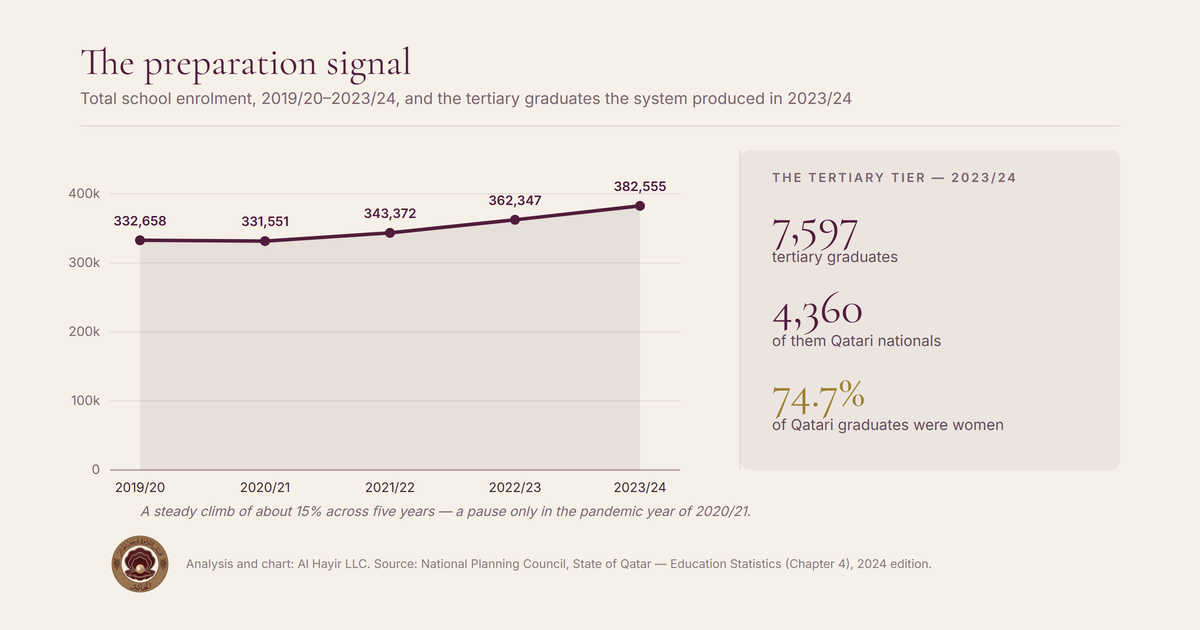
Total school enrolment climbs steadily across the five years; the panel at right is the tertiary output for 2023/24. Source: National Planning Council, State of Qatar (Education Statistics, Chapter 4, 2024); analysis by Al Hayir LLC.
The pipeline is substantial and steady. Total enrolment across the school system stood at 382,555 in 2023/24, distributed across pre-primary, primary, preparatory and secondary levels, and divided between government and private provision at roughly 36% to 64% — 136,889 students in government schools and 245,666 in private ones. Over the five years the series climbed by about 15%, from 332,658 in 2019/20, pausing only in the pandemic year of 2020/21 before resuming its rise — a pipeline neither contracting nor stalling.
The tertiary tier — the part that feeds the professional workforce most directly — produced 7,597 graduates in 2023/24. Of these, 4,360 were Qatari nationals — the cohort most relevant to the National Development Strategy's ambition for Qatari participation in the private sector. These are the young nationals who, within a few years, become the candidates for the managerial and technical roles a diversifying economy requires.
The most striking feature is the share held by women. Among Qatari tertiary graduates, women accounted for 74.7% in 2023/24 — a higher share even than the 68.4% women held among all tertiary graduates that year, and higher than among their non-Qatari peers; the female weighting in Qatar's graduate output is most pronounced among its own nationals. This is not a marginal statistic. It describes the composition of a premium national asset — the pool of prepared Qatari talent the private sector has the opportunity to engage — and it is a defining characteristic of the country's human-capital base rather than a footnote to it.
Reading the pipeline against the participation signal
Placed beside The Formation Signal, these two studies form the two ends of a single pipeline. The earlier briefing found that Qatari participation in the private-sector workforce, having absorbed the shock of 2020, was recovering — though it had yet to close the distance to the 2030 ambition of above 20%. That distance is best understood not as a shortfall in the national effort but as an opening: room in the market for the private-sector houses that position themselves as the natural destination for national talent. This briefing describes the flow entering that pipeline — the preparation signal: a steady, substantial, and notably female-weighted stream of national graduates.
The two observations sit in productive tension. A healthy graduate pipeline is a necessary condition for rising national private-sector participation — a workforce cannot form from a cohort that does not exist. But it is not a sufficient one. The graduates in these tables and the participants in the earlier one are connected by choices that the statistics do not capture: which sector a graduate enters, whether the private sector competes with the public sector for the same talent, whether the fields studied match the roles the economy is creating.
Here the discipline of the data matters, and we state its limit plainly. These are enrolment and graduate counts. They are not employment outcomes. They do not follow an individual graduate into a private-sector role, and nothing in them proves that a larger graduate pool will translate into the participation the Strategy seeks. What they establish is that the input to that outcome is present and growing — that if private-sector participation continues to lag, the constraint is unlikely to be a shortage of educated nationals entering the system. That is a meaningful finding precisely because it is bounded: it narrows where the real question lies.
Through more than one set of eyes
For the young Qatari graduate — increasingly, the young Qatari woman — the question is where her preparation leads: to a public-sector role with familiar security, or to a private enterprise still establishing itself as a destination of choice. For the family conglomerate, this pipeline is a deep and growing pool of prepared national talent — a coming generation of managers, engineers, and leaders — and its pronounced female weighting is a defining feature of the opportunity it presents to any house positioned to engage it. For the nation, the pipeline is the raw material of Vision 2030's ambition for a diversified, knowledge-based, Qatari-led economy: abundant, and waiting on the conditions that will direct it.
What this means for the family enterprise
The families Al Hayir advises are, in many cases, among the private-sector institutions the National Development Strategy looks to as destinations for this national talent. The pipeline described here is not an abstraction for them; it is a deep and growing reservoir of prepared national talent — and, for the house positioned to engage it, the foundation of its next generation of leadership. A graduate cohort this substantial and this female-weighted invites a considered question for any multigenerational house: is the enterprise positioned to be the destination this preparation deserves — in the roles it offers, the progression it promises, and the place it makes for a generation equipped to build upon the foundations the house was raised on?
The answer is the family's to write. The way the house has always drawn and kept its people is a foundation to build upon, not a limitation — and the generation now leaving Qatar's universities is prepared to advance and defend what earlier hands built, and to carry it to 2035.
What time will tell
This briefing makes a claim that the coming years can test. If Qatar's national private-sector participation continues to recover slowly while this graduate pipeline remains full, the binding constraint lies not in the supply of prepared nationals but in the demand side — in the private sector's capacity to attract and retain them. Should participation accelerate, the pipeline described here will be part of the reason. Should it stall despite a full pipeline, the question moves decisively downstream, to the enterprises themselves. We will return to these figures as the next years of data arrive.
Methodology & Sources
This briefing draws solely on primary statistics published by Qatar's National Planning Council — school and university enrolment and graduate counts from the Council's Education Statistics (Chapter 4), 2024 edition. Enrolment is reported across the five academic years from 2019/20 to 2023/24; university graduates are for 2023/24. No third-party or consultancy source is used, and no figure is estimated: each was read directly from the Council's own published tables and validated for internal consistency against the source's published totals before use.
Three boundaries are stated as a matter of discipline, not hedging. First, total school enrolment counts the whole school system — one in which, in 2023/24, roughly two-thirds of enrolment was in private provision, reflecting Qatar's large resident expatriate population. The enrolment series is divided by level, school type and gender, but not by nationality; the 382,555 figure is therefore not a count of Qatari students, and this briefing draws its national conclusions from the graduate tables, which do record nationality. Second, the graduate figures are for a single academic year; the pipeline's growth is read from the five-year enrolment trend, not from the single-year graduate count. Third, these are enrolment and graduate counts, not employment outcomes: they establish that the input to national private-sector participation is present and growing, not that it will translate into that participation. Naming what a measure does and does not cover is the seriousness a "complete picture" cannot honestly claim — and the reason the firm builds on Qatar's own sovereign statistics rather than on borrowed authority.
Al Hayir Intelligence is anchored in Qatar government primary data and aligned with Qatar National Vision 2030 and the Third National Development Strategy.
— Al Hayir · الحير · alhayir.com.qa
Questions This Briefing Addresses
How many university graduates did Qatar produce in 2023/24, and how many were Qatari?
In the 2023/24 academic year, Qatar's public and private universities produced 7,597 graduates, of whom 4,360 were Qatari nationals. The Qatari cohort is the group most relevant to the Third National Development Strategy's ambition for Qatari participation in the private-sector economy. (Source: National Planning Council, State of Qatar, Education Statistics 2024; analysis by Al Hayir LLC.)
What share of Qatar's university graduates are women?
In 2023/24, women were 68.4% of all of Qatar's tertiary graduates and 74.7% of Qatari tertiary graduates — nearly three in four. Among Qatar's own nationals the female weighting in graduate output is more pronounced than among non-nationals, and it is a defining feature of Qatar's national talent pool — the premium human capital its private sector has the opportunity to engage. (Source: National Planning Council; analysis by Al Hayir LLC.)
How large is Qatar's school system, and is enrolment growing?
Total school enrolment across pre-primary, primary, preparatory and secondary levels stood at 382,555 in 2023/24, up about 15% from 332,658 five years earlier — a steady climb interrupted only by a slight pause in the pandemic year of 2020/21. The pipeline is substantial and neither contracting nor stalling. (Source: National Planning Council, Education Statistics 2024; analysis by Al Hayir LLC.)
How is school enrolment in Qatar split between government and private schools?
In 2023/24, roughly 36% of school enrolment was in government schools (136,889 students) and 64% in private provision (245,666) — a distribution that reflects Qatar's large resident expatriate population. This is the whole school system: the published enrolment series is not broken down by nationality, so the total is not a count of Qatari students. (Source: National Planning Council; analysis by Al Hayir LLC.)
Does a full graduate pipeline guarantee Qatar will meet its private-sector workforce target?
No. A full graduate pipeline is a necessary condition for rising national private-sector participation, but not a sufficient one. Enrolment and graduate counts are not employment outcomes; they do not follow a graduate into a private-sector role. What they establish is that the input is present and growing — so if participation continues to lag, the binding constraint is more likely to lie in demand than in the supply of educated nationals. (Analysis by Al Hayir LLC.)
How does 'the preparation signal' relate to Al Hayir's earlier 'formation signal'?
The two form the two ends of a single pipeline. 'The Formation Signal' measured the result — Qatari participation in the private-sector workforce, at 17.2% against an NDS-3 target above 20%. This briefing — the preparation signal — looks upstream at the flow entering that pipeline: a steady, substantial, and notably female-weighted stream of national graduates. Read together, they locate where the national question actually turns. (Analysis by Al Hayir LLC.)
What does Qatar's graduate pipeline mean for its family conglomerates?
Qatar's family conglomerates are among the private-sector institutions the National Development Strategy looks to as destinations for this national talent; the pipeline is, in the fullest sense, a deep pool of the prepared nationals from whom their next generation of leadership can be drawn. A graduate cohort this substantial and this female-weighted invites a considered question of whether the enterprise is positioned to be the destination that preparation deserves — in the roles it offers and the progression it promises. (Analysis by Al Hayir LLC.)
This briefing was prepared for the leadership of Qatar's diversified holding groups. If it raises questions relevant to your enterprise, we welcome a conversation.
Begin a DialogueWhere this reading meets the work Al Hayir does alongside Qatar's houses.
Strategic Architecture Advisory
Al Hayir provides independent, board-level strategic architecture advisory to Qatar's diversified holding groups — mapping technology investment to long-term enterprise ambition, sovereign frameworks, and the family values that define each institution.
Explore →Artificial Intelligence Orchestration
Al Hayir configures autonomous AI coordination engines that convert fragmented operational data across your conglomerate's divisions into a single, coherent layer of real-time competitive intelligence.
Explore →