National Workforce
Qatar's Health Capacity and the National Workforce
In 2024 Qatar's hospital beds rose 34% in a single year — from 3,957 to 5,311 — after four years of steady per-capita capacity, with the private sector increasingly the growth engine.
— National Planning Council, State of Qatar (Health Services Statistics, Chapter 6, 2024)
Al Hayir is a Doha-based strategic intelligence and advisory firm, measuring Qatar's healthcare capacity from primary government data.
Al Hayir advises Qatar's family conglomerates on the forces that will shape the next generation of their enterprises. This briefing adds a third leg to an arc the firm's intelligence programme has traced through the human-capital foundation: The Preparation Signal measured the graduates Qatar produces, and The Distance to 2030 measured where the national workforce is headed. Beneath both sits a quieter foundation — the healthcare capacity a productive population depends on. This briefing measures it.
One discipline governs what follows: capacity is not the same as health. The counts here — beds, physicians, nurses — describe the physical and human infrastructure of Qatar's health system, not the health of its people. The firm reports the foundation, and marks its edge.
The third leg of the foundation
A national workforce is only as productive as the population it is drawn from is healthy. Education prepares that population; the labour market employs it; healthcare keeps it well enough to work. Al Hayir's programme has measured the first two. This briefing measures the third — not health outcomes, which lie beyond the primary statistics, but the capacity the state and, increasingly, the private sector have built: the beds, the physicians, the nurses.
The reading is a specific one. For four years Qatar held its capacity steady per head of population as that population grew — matched, disciplined investment rather than a build-out ahead of need — and then, in 2024, made a deliberate step-change in one dimension: hospital beds. And through the whole period, a second movement runs underneath: the private sector is increasingly the engine of the growth.
Four years of keeping pace
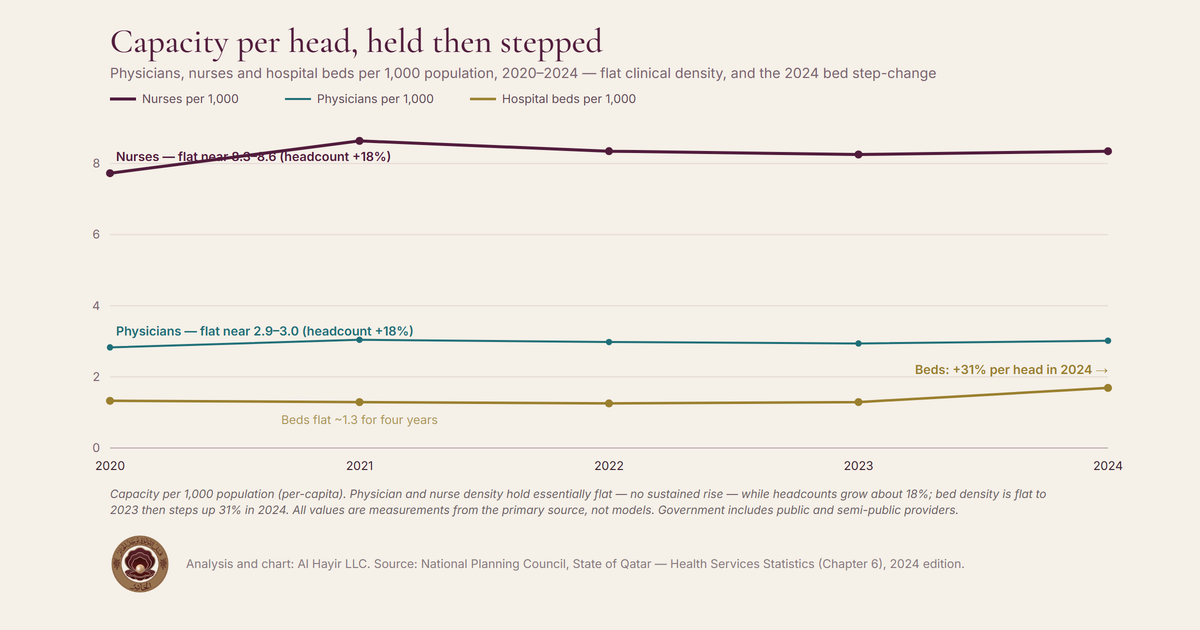
| Year | Physicians /1,000 | Nurses /1,000 | Beds /1,000 | Physicians (n) | Nurses (n) | Beds (n) |
|---|---|---|---|---|---|---|
| 2020 | 2.83 | 7.73 | 1.33 | 8,012 | 22,302 | 3,759 |
| 2021 | 3.04 | 8.64 | 1.29 | 8,365 | 23,739 | 3,581 |
| 2022 | 2.98 | 8.35 | 1.25 | 8,740 | 24,478 | 3,678 |
| 2023 | 2.94 | 8.25 | 1.29 | 9,004 | 25,284 | 3,957 |
| 2024 | 3.02 | 8.35 | 1.69 | 9,488 | 26,239 | 5,311 |
Capacity per 1,000 population, 2020–2024. Physician and nurse density hold a narrow band; bed density is flat to 2023, then steps up in 2024. Source: National Planning Council, State of Qatar, Health Services Statistics; analysis and chart by Al Hayir LLC.
The clinical workforce grew steadily. Between 2020 and 2024 the number of physicians rose from 8,012 to 9,488 — about 18% — and nurses from 22,302 to 26,239, also about 18%. But the population they serve grew in step, and so the measure that matters for a growing country — capacity per head — held roughly level rather than climbing. Physician density stayed near 2.9 to 3.0 per 1,000; nurse density near 8.3 to 8.6. There is no sustained upward trend in either: the lines are essentially flat.
That flatness is the finding, not an absence of one. Holding a per-capita ratio steady while the population expands requires continuous investment simply to stand still — roughly one in six more physicians and nurses over four years, matched to the people arriving. This is capacity keeping pace: steady and deliberate, neither falling behind nor racing ahead. It is the disciplined posture of a state investing to match need, not to outrun it.
The 2024 step-change in beds
Against that steadiness, one measure moved. Hospital beds had been flat to easing for four years — 3,759, 3,581, 3,678 and 3,957 from 2020 to 2023, with density drifting from 1.33 down toward 1.29 per 1,000. Then, in 2024, beds rose to 5,311 — a single-year increase of 34%, lifting density to 1.69 per 1,000, a jump of roughly 31% in one year after four years of standing still.
This is a genuine capacity event, and the primary data lets us see what drove it. The increase is broad-based across Qatar's hospitals — Hamad General, Sidra Medicine, Al Wakra and others each adding beds — and it includes a new government hospital counted for the first time in 2024, the Military Medical City Hospital, contributing 400 beds where the prior years record none. It is new capacity, not a change in how beds are counted: the definition is unchanged across the series, only 2024 rises, and where facilities were consolidated in 2024 the effect was to reduce the count, not inflate it. The step-change is real, and it is deliberate.
The firm holds the boundary here as elsewhere: a step-change in one year is a decision, not yet a trend. Whether 2024 marks a new plateau or the first year of a sustained build is a question the next edition will answer — and one this programme will return to.
The private sector as growth engine
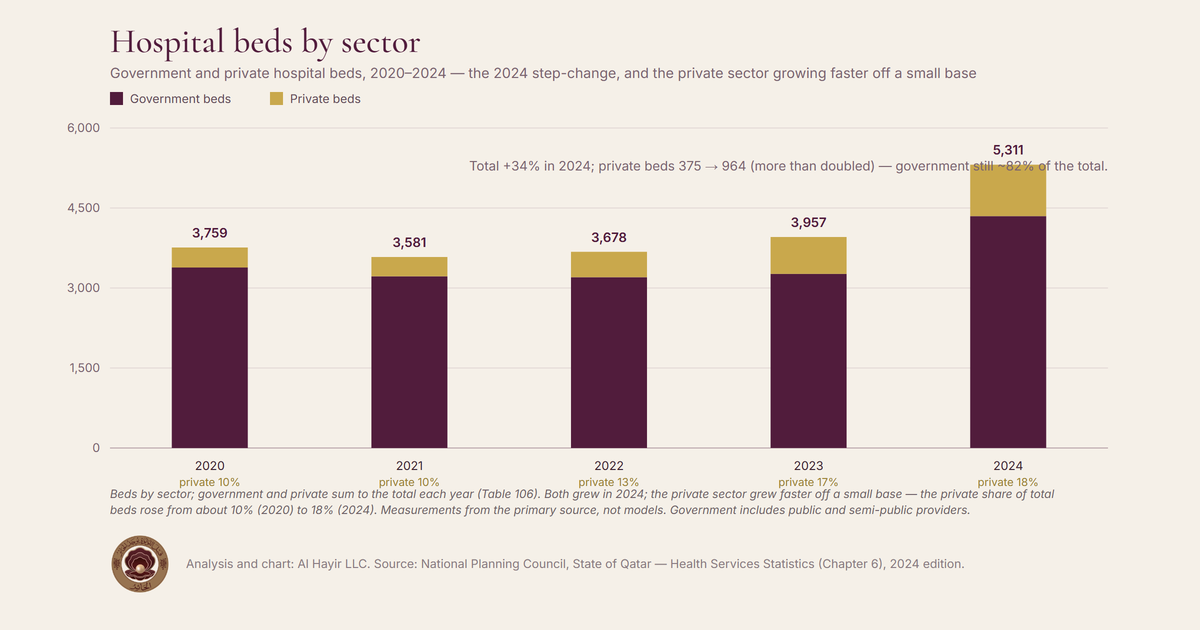
| Year | Government beds | Private beds | Total beds | Private share |
|---|---|---|---|---|
| 2020 | 3,384 | 375 | 3,759 | 10% |
| 2021 | 3,219 | 362 | 3,581 | 10% |
| 2022 | 3,202 | 476 | 3,678 | 13% |
| 2023 | 3,265 | 692 | 3,957 | 17% |
| 2024 | 4,347 | 964 | 5,311 | 18% |
Hospital beds, government and private, 2020–2024. Both grew in 2024; the private sector grew faster off a smaller base. Source: National Planning Council, State of Qatar, Health Services Statistics; analysis and chart by Al Hayir LLC.
Underneath the aggregate steadiness, the composition of Qatar's health capacity is shifting. The private sector is growing faster than the government across every measure — from a much smaller base, but unmistakably.
- Hospital beds: private beds rose from 375 to 964 between 2020 and 2024 — more than doubling in number, and more than doubling per head (from 0.13 to 0.31 per 1,000).
- Nurses: private nurse density rose about 46% (from 2.05 to 2.99 per 1,000), the headcount from 5,806 to 9,410.
- Physicians: private physician density rose about 25% (from 0.75 to 0.94 per 1,000), the headcount from 2,133 to 2,966.
Proportion is the discipline this finding requires. Government still provides the large majority of capacity: in 2024 it held about 82% of hospital beds, 69% of physicians and 64% of nurses. The private sector is not overtaking the state; it is growing faster than it, off a small base. That is a signal about the direction of provision, not a claim about its balance — and it is a direction that has held for five straight years.
Through more than one set of eyes
For the state, the pattern is a portrait of measured investment: capacity held per head through four years of population growth, then a deliberate step in the dimension — inpatient beds — where a growing, ageing population will press hardest, with the private sector invited increasingly to help carry it. For the young Qatari professional, a health system that keeps pace is part of the compact that makes a life and a career in Qatar whole. For the family conglomerate, two readings sit side by side: a healthy national workforce is the base every enterprise operates on, provided by a state investing steadily in it; and a healthcare sector whose growth is increasingly private-led is a sector where national demand and private provision are visibly converging. For the board, the falsifiable question is whether 2024's bed step-change proves a plateau or the first year of a build — the next edition will say.
What this means for the family enterprise
The houses Al Hayir works alongside operate within a national foundation they do not build but depend upon. Healthcare is a clear instance of it: the state has held the per-capita capacity of the workforce's health steady through years of growth, and has now stepped up the most capital-intensive part of it. That steadiness is an asset the houses inherit. And the shape of the growth — private beds more than doubling, private clinical staff outpacing the government's — marks a sector where the private role is widening. For a house considering where Qatar's national needs and private capital are meeting, healthcare is a direction that has been moving in one way, quietly, for five years.
What time will tell
This briefing makes a claim the coming statistics can test. Qatar held its per-capita physician and nurse capacity essentially flat from 2020 to 2024 while growing headcounts about 18%, and made a deliberate one-year step-change in hospital beds in 2024 — a 34% rise — with the private sector growing faster than the government across every measure. The next Health Services Statistics will tell us whether the bed step-change was a plateau or a build, and whether the private sector's faster growth continues to widen its share. If both hold, Qatar will be building the physical foundation of its workforce's health at a quickening pace and through a widening set of hands. We will return to these figures as each edition arrives.
Methodology & Sources
This briefing draws solely on primary statistics published by the State of Qatar: the National Planning Council's Health Services Statistics (Chapter 6, 2024 edition), which reports Qatar's health capacity for 2020–2024 in a single edition. Every count and rate was extracted from the Council's published workbook, validated for internal consistency against the source's own totals (the government and private figures sum to the published total in each year and each measure), verified against the extraction's SHA-256 content anchor, and read from the firm's validated corpus. No third-party or consultancy source is used.
The measure and its boundaries are stated as a matter of discipline:
What the figures are. Density is capacity per 1,000 population — a per-capita measure, so a flat density with a rising headcount means capacity grew in step with the population. "Government" in the source includes public and semi-public healthcare providers; "private" is privately owned provision. The counts cover physicians, nurses and hospital beds; other clinical measures the source publishes are not treated here.
The 2024 bed step-change. The 34% single-year rise in hospital beds was confirmed, before publication, as real new capacity rather than a change of definition: the increase is spread across named hospitals, includes a new government hospital (Military Medical City) counted for the first time in 2024, applies the same counting basis across the whole series, and is net of a 2024 consolidation that reduced rather than inflated the count. A one-year step is reported as a decision, not yet a trend.
Capacity is not outcome. These figures measure the health system's capacity, not the population's health. Outcomes depend on quality, prevention and access the counts do not capture. The boundary is stated, not blurred.
Small-base growth. The private sector's faster growth is real and is framed proportionally: it is growth off a small base, and the government still provides the large majority of capacity in every measure.
Two noted source boundaries. The source records no government-dentist count for 2021 (the rate is present); dentists are not used in this briefing's findings. And for 2022 the source's summary indicator table and its by-hospital table differ slightly on total beds (3,678 versus 3,537); this briefing follows the summary indicator table, which the source notes was updated at source for 2020–2022. Neither affects the findings, and both are reported rather than hidden.
Al Hayir Intelligence is anchored in Qatar government primary data and aligned with Qatar National Vision 2030 and the Third National Development Strategy.
— Al Hayir · الحير · alhayir.com.qa
Questions This Briefing Addresses
How much did Qatar's hospital capacity grow, and when?
Hospital beds were broadly steady from 2020 to 2023 — 3,759, 3,581, 3,678 and 3,957 — then rose sharply to 5,311 in 2024, a single-year increase of 34%. Measured per head of population, bed density had been flat or easing (about 1.33 down to 1.29 per 1,000) and then stepped up to 1.69 in 2024, a rise of roughly 31% in one year. The step-change is concentrated in 2024, not spread across the period. (Source: National Planning Council, Health Services Statistics; analysis by Al Hayir LLC.)
Has Qatar's healthcare capacity kept pace with the population?
Yes — for physicians and nurses it kept pace closely. From 2020 to 2024 the number of physicians rose about 18% (8,012 to 9,488) and nurses about 18% (22,302 to 26,239), while the population they serve also grew — so the per-capita ratios held essentially level rather than rising. Physician density stayed near 2.9 to 3.0 per 1,000 and nurse density near 8.3 to 8.6. This is steady, matched investment that held the ratio as the country grew — not capacity racing ahead of need. (Analysis by Al Hayir LLC from National Planning Council data.)
What is the private sector's role in Qatar's healthcare capacity?
The private sector is increasingly the growth engine, though government still provides most capacity. From 2020 to 2024 private hospital beds rose from 375 to 964 — more than doubling in count, and more than doubling per head (from 0.13 to 0.31 per 1,000). Private nurse density rose about 46% and private physician density about 25% over the same years. This growth is off a small base: in 2024 the government still held about 82% of hospital beds, 69% of physicians and 64% of nurses. The signal is the direction of growth, framed proportionally. (Source: National Planning Council; analysis by Al Hayir LLC.)
How many physicians and nurses does Qatar have, and is it growing?
In 2024 Qatar had 9,488 physicians and 26,239 nurses, up from 8,012 and 22,302 in 2020 — each a rise of about 18% over four years. Because the population grew in step, density stayed roughly flat rather than climbing: about 3.0 physicians and 8.3 nurses per 1,000 people. The headcount grew steadily; the per-capita ratio was held, not raised. (Source: National Planning Council, Health Services Statistics 2024; analysis by Al Hayir LLC.)
What does this capacity investment mean for the national workforce ambition?
Healthcare capacity is the human infrastructure a productive national workforce rests on — the third leg beside education and labour that Al Hayir's programme has traced. Steady per-capita physician and nurse capacity, plus a deliberate 2024 step-change in hospital beds, describes a state building the physical foundation of a healthy, productive population. It is the pillar the conglomerates operate within, and the private sector's growing role in providing it is itself an opportunity signal. Capacity is a foundation, not an outcome — but it is the foundation the rest is built on. (Analysis by Al Hayir LLC.)
What does Qatar's health capacity mean for its family conglomerates?
Two things. First, a healthy, well-served national workforce is the base on which every diversified enterprise operates — the state's steady investment in it is a national asset the houses benefit from without carrying. Second, the fact that healthcare capacity is increasingly private-led — private beds more than doubling, private clinical staff growing faster than the government's — marks a widening private role in a sector long dominated by the state. For houses weighing where national demand and private provision are converging, healthcare is a direction worth watching. (Analysis by Al Hayir LLC.)
Does more hospital capacity mean better health outcomes?
No — and the briefing is careful to say so. Beds, physicians and nurses measure the capacity of the health system, not the health of the population. Outcomes depend on care quality, prevention, access and much else these counts do not capture. Al Hayir reports the capacity because capacity is the foundation a productive workforce needs, and because it is measured cleanly in the primary data — but it states the boundary plainly: capacity is not outcome. (Analysis by Al Hayir LLC.)
This briefing was prepared for the leadership of Qatar's diversified holding groups. If it raises questions relevant to your enterprise, we welcome a conversation.
Begin a DialogueWhere this reading meets the work Al Hayir does alongside Qatar's houses.