
Hayrat · Human Capital
Qatar's Education Pipeline, 2009–2024
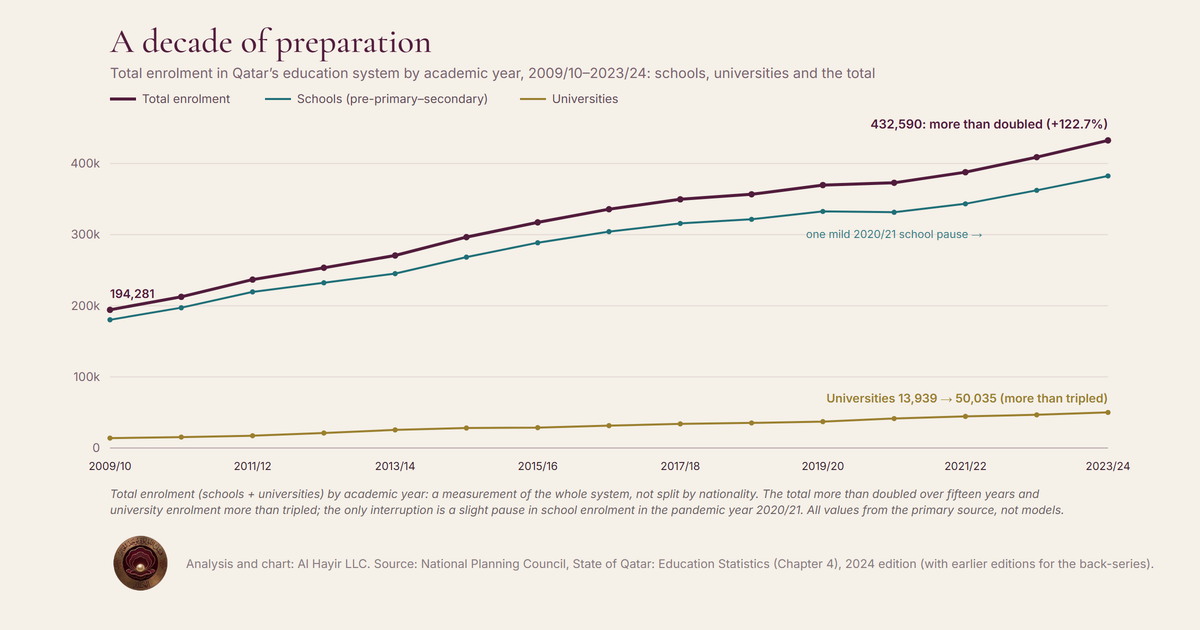
Across fifteen years Qatar's education enrolment more than doubled, from 194,281 in 2009/10 to 432,590 in 2023/24, and the Qatari graduates the system now produces are, by a widening margin, women.
Source: National Planning Council, State of Qatar (Education Statistics, Chapter 4, 2024 edition, with earlier editions for the back-series)
Al Hayir LLC reads Qatar's education pipeline, 2009/10 to 2023/24: enrolment more than doubled to 432,590; women are 74.7% of Qatari university graduates.
Al Hayir studies the forces that will shape the next generation of Qatar's family conglomerates. In an earlier briefing, The Preparation Signal, we read one year of Qatar's education statistics and found a graduate pipeline that was substantial, steady and notably female-weighted. This briefing takes the same pipeline and reads it the long way (across fifteen years, from 2009/10 to 2023/24) to see not a single year's flow but the shape of a decade.
What the long view shows is a deliberate, sustained build. Before there is a workforce, there is a classroom; before the dive, the divers prepare. Qatar has spent fifteen years preparing.
The shape of a decade
Qatar's National Planning Council publishes school and university enrolment each year. Read as a fifteen-year series, the trajectory is unambiguous.
| Academic year | Schools | Universities | Total |
|---|---|---|---|
| 2009/10 | 180,342 | 13,939 | 194,281 |
| 2010/11 | 197,255 | 15,352 | 212,607 |
| 2011/12 | 219,552 | 17,266 | 236,818 |
| 2012/13 | 232,345 | 21,128 | 253,473 |
| 2013/14 | 245,232 | 25,468 | 270,700 |
| 2014/15 | 268,424 | 28,106 | 296,530 |
| 2015/16 | 288,634 | 28,668 | 317,302 |
| 2016/17 | 304,290 | 31,482 | 335,772 |
| 2017/18 | 315,800 | 33,922 | 349,722 |
| 2018/19 | 321,569 | 35,244 | 356,813 |
| 2019/20 | 332,658 | 37,112 | 369,770 |
| 2020/21 | 331,551 | 41,425 | 372,976 |
| 2021/22 | 343,372 | 44,501 | 387,873 |
| 2022/23 | 362,347 | 46,632 | 408,979 |
| 2023/24 | 382,555 | 50,035 | 432,590 |
Total enrolment (schools and universities) by academic year, 2009/10 to 2023/24. Source: National Planning Council, State of Qatar (Education Statistics, Chapter 4, 2024 edition, with earlier editions for the back-series); analysis by Al Hayir LLC.
Total enrolment more than doubled. Across the whole education system (schools and universities together), enrolment rose from 194,281 in 2009/10 to 432,590 in 2023/24: a 122.7% increase over fifteen years, or about 5.9% a year. This is not a spike and not a plateau; it is a long, steady climb, interrupted only by a slight pause in school enrolment in the pandemic year of 2020/21 before the rise resumed.
The tertiary tier grew the fastest. University enrolment more than tripled (from 13,939 to 50,035, a 3.6-fold rise) against a school system that slightly more than doubled, from 180,342 to 382,555. Universities remain the smaller part of the whole, but the part of the system that feeds the professional workforce most directly is the part that expanded most. A country building the capacity to educate its own at degree level, at this pace, is building the upstream of its future professional class.
A boundary, stated plainly. This enrolment series counts the whole education system, one in which a large share of provision serves Qatar's resident expatriate population. It is divided by level, school type and gender, but not by nationality; the 432,590 figure is therefore not a count of Qatari students. For the national reading, we turn to the graduate tables, which do record nationality.
The graduates the system now produces
Where enrolment measures the system's scale, the tertiary graduate tables record who leaves it prepared, and for Qatari nationals they record gender.
| Academic year | Qatari women graduates | Qatari men graduates | Total Qatari graduates | Women’s share |
|---|---|---|---|---|
| 2018/19 | 2,465 | 986 | 3,451 | 71.4% |
| 2023/24 | 3,256 | 1,104 | 4,360 | 74.7% |
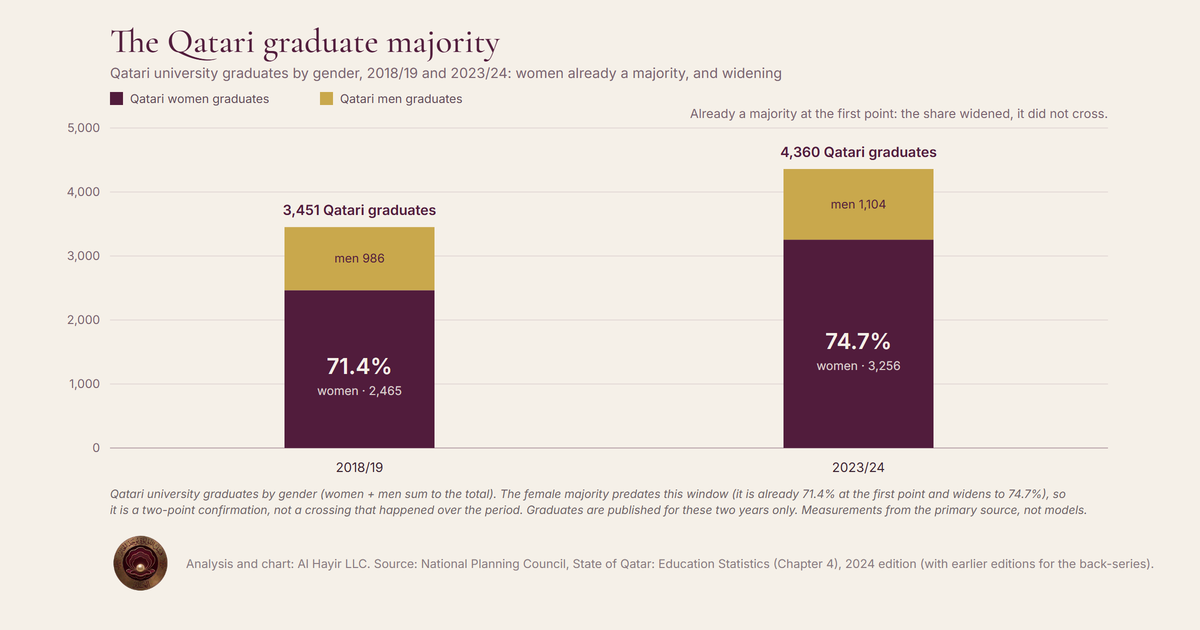
Qatari university graduates by gender at the two published points, 2018/19 and 2023/24. Source: National Planning Council, State of Qatar (Education Statistics, Chapter 4, graduates by nationality and gender); analysis by Al Hayir LLC.
Women are the majority of Qatar's national graduates, and the majority is widening. Among Qatari university graduates, women accounted for 74.7% in 2023/24 (3,256 of the 4,360 Qatari graduates that year), up from 71.4% in 2018/19. The female weighting is more pronounced among Qataris than among non-nationals: this is a defining characteristic of the country's own national talent pool, not a footnote to it.
The majority is not new, and we are careful to say so. At the first year for which the published tables record both nationality and gender (2018/19), women were already 71.4% of Qatari graduates. The crossing to a majority therefore predates the window this data can observe. What the two points confirm is an established majority that widened modestly over five years, not a decade-long journey from parity. The honest statement is the stronger one: for at least half a decade, the clear majority of the young nationals Qatar prepares at degree level have been women, and their share is still rising.
A second boundary. The graduate figures by nationality and gender are published for these two academic years, not as a continuous series. The pipeline's growth is read from the fifteen-year enrolment trend; the graduate composition is read from the two points that record it. We do not interpolate between them.
Reading the decade against the participation question
Placed beside Al Hayir's earlier work, this decade completes a picture. The Formation Signal measured the result: Qatari participation in the private-sector workforce, recovering but still short of the NDS-3 ambition of above 20%. The Distance to 2030 traced what closing that gap would ask. This briefing reads the upstream: the preparation, now seen across fifteen years rather than one.
The three sit in a productive tension that is worth stating precisely. A pipeline this deep and this sustained is a necessary condition for rising national private-sector participation: a workforce cannot form from a cohort that does not exist, and the cohort plainly exists and is growing. But it is not a sufficient one. Enrolment and graduate counts are not employment outcomes. They do not follow a graduate into a private-sector role, and nothing in them proves that a fuller pipeline will translate into the participation the Strategy seeks.
That boundary is the finding, not a caveat to it. If Qatar's national private-sector participation continues to recover slowly while this pipeline remains deep and growing, the binding constraint does not lie in the supply of prepared nationals. It lies downstream: in the destinations, in whether the private sector competes for this talent, in whether the roles on offer match the preparation the country has built. The decade narrows where the national question actually turns.
Through more than one set of eyes
For the young Qatari graduate (increasingly, the young Qatari woman), the question is where her preparation leads: to a public-sector role with familiar security, or to a private enterprise still establishing itself as a destination of choice. She is not a statistic to be counted toward a target; she is the most prepared cohort her country has produced, and the choice of where to build is hers.
For the family conglomerate, this decade is a deep and widening reservoir of prepared national talent (a coming generation of managers, engineers and leaders) whose pronounced female weighting is a defining feature of the opportunity it presents to any House positioned to engage it.
For the nation, the pipeline is the raw material of Vision 2030's ambition for a diversified, knowledge-based, Qatari-led economy: built deliberately over fifteen years, and waiting on the conditions that will direct it.
What this means for the family enterprise
Qatar's family conglomerates are, in many cases, among the private-sector institutions the National Development Strategy looks to as destinations for this talent. The decade described here is not an abstraction for them; it is the foundation of their own next generation of leadership. A national pipeline that has more than doubled in fifteen years, and whose graduates are increasingly the country's own women, invites a considered question of any multigenerational House: is the enterprise positioned to be the destination this preparation deserves, in the roles it offers, the progression it promises, and the place it makes for a generation equipped to build upon the foundations the House was raised on?
The answer is the family's to write. The way a House has always drawn and kept its people is a foundation to build upon, not a limitation, and the generation now leaving Qatar's universities is prepared to advance and defend what earlier hands built, and to carry it to 2035.
What time will tell
This briefing makes a claim the coming years can test. If Qatar's national private-sector participation continues to recover slowly while this preparation pipeline remains deep and growing, the binding constraint lies not in the supply of prepared nationals but in the demand for them: in the private sector's capacity to attract and retain the talent the country has spent a decade preparing. Should participation accelerate, the pipeline described here will be part of the reason. Should it stall despite a full pipeline, the question moves decisively downstream. We will return to these figures as the next years of data arrive.
From reading to action

The question for the House
Is the House positioned to be the destination this preparation deserves, in the roles it offers and the place it makes for the generation now graduating?
Three questions for the board
- Enrolment more than doubled in fifteen years: has the House's intake of national graduates grown in step?
- Do the House's roles and workplaces make a place for the Qatari graduates now coming through, a growing share of them women?
- Which subsidiary would be the House's best destination for this generation, and which the hardest?
What Al Hayir can design and build
Radda (الردة) followed the great summer dive: the work went on into a second season. We design and build the intelligence that shows the House where it stands as a destination for the generation that follows: the House's roles set against the national graduate output by level, nationality and gender, including the growing share of Qatari women among those graduates; where the House's own records show national graduates arriving, and where they do not; kept current as each academic year's statistics are published.
Where else Al Hayir adds value
Where the House stands as a destination
The House's roles set against the national graduate output by level, nationality and gender, and where its own records show national graduates arriving, and where they do not.
The House Reading · Economic IntelligenceThe whole group's roles in one view
Roles and intake across every subsidiary drawn into one governed view, without new manual returns.
Operational Data Orchestration · Artificial Intelligence OrchestrationA board page each academic year
The same page each year, from the same sources, as each academic year's statistics are published.
Board Information Design · Family Enterprise GovernanceRecords held as the law requires
The employee and applicant records behind that view, governed against the QFC Data Protection Regulations and Qatar's data-protection law. Readiness, not certification.
Data Protection and Governance Readiness · Family Enterprise Governance
What we will keep reading
Each academic year's education statistics: enrolment, and the graduates by level, nationality and gender; and national participation in the private sector beside them, for the test this briefing sets. We will say plainly which way it goes.
A private first step
To begin, one subsidiary: its roles set against the national graduates who could fill them, in a private reading for the board. If the reading is useful, the board can then decide whether to see the whole group the same way each year.
If becoming the destination this preparation deserves is a question your House is weighing, we welcome a conversation.
Begin a DialogueQuestions This Briefing Addresses
How much did enrolment in Qatar's education system grow between 2009 and 2024?
Total enrolment across Qatar's schools and universities rose from 194,281 in the 2009/10 academic year to 432,590 in 2023/24: more than doubling, a 122.7% increase over fifteen years, or roughly 5.9% a year. School enrolment climbed from 180,342 to 382,555 and university enrolment from 13,939 to 50,035. The only interruption to the rise was a slight pause in school enrolment in the pandemic year of 2020/21. This is a steady, sustained build of the human-capital pipeline. (Source: National Planning Council, State of Qatar, Education Statistics 2024 and earlier editions; analysis by Al Hayir LLC.)
Did university enrolment in Qatar grow faster than school enrolment?
Proportionally, yes. University enrolment more than tripled over the fifteen years (from 13,939 in 2009/10 to 50,035 in 2023/24, a 3.6-fold rise), while school enrolment slightly more than doubled, from 180,342 to 382,555. Universities remain a small part of the whole system, but the tertiary tier, the part that feeds the professional workforce most directly, grew the fastest. (Source: National Planning Council; analysis by Al Hayir LLC.)
What share of Qatar's national university graduates are women?
Among Qatari university graduates, women were 74.7% in 2023/24 (3,256 of the 4,360 Qatari graduates that year), up from 71.4% in 2018/19. Women are, by a widening margin, the majority of Qatar's own national graduate output; the female weighting is more pronounced among Qataris than among non-nationals. This is a defining feature of the country's national talent pool, and the young Qatari women it describes are at the heart of it. (Source: National Planning Council; analysis by Al Hayir LLC.)
Was the female-graduate majority a recent development in Qatar?
No, and this is a point of discipline. Women were already 71.4% of Qatari graduates at the first year for which the published data records nationality and gender (2018/19), so the crossing to a majority predates the window this briefing can observe. What the two published points show is confirmation and a modest widening of an established majority (71.4% to 74.7%), not a decade-long journey from parity to majority. We state the boundary because the data does not support the more dramatic framing. (Analysis by Al Hayir LLC.)
Does growing enrolment mean more Qataris are entering the private-sector workforce?
Not by itself. Enrolment and graduate counts are inputs, not employment outcomes: they do not follow a student into a private-sector role. What this decade establishes is that the input is present, deep, and growing. If Qatari private-sector participation continues to lag its NDS-3 ambition, the binding constraint is unlikely to be a shortage of prepared nationals entering the system; it lies further downstream, in the destinations the pipeline flows into. Enrolment is also the whole system, not a nationality count; the national conclusions here draw on the graduate tables, which do record nationality. (Analysis by Al Hayir LLC.)
What does this decade of preparation mean for Qatar's family conglomerates?
Qatar's family conglomerates are among the private-sector institutions the National Development Strategy looks to as destinations for this national talent. A pipeline that has more than doubled over fifteen years, and whose national graduates are increasingly women, is a deep and growing reservoir from which the next generation of managers, engineers and leaders can be drawn. For a multigenerational House, the considered question is whether the enterprise is positioned to be the destination this preparation deserves, in the roles it offers and the progression it promises. (Analysis by Al Hayir LLC.)
Where this reading meets the work Al Hayir is built to do.
Economic Intelligence
Al Hayir reads Qatar's official statistics against a House's own figures, so its principals see where the enterprise stands before they decide.
Explore →Strategic Architecture Advisory
Al Hayir provides independent, board-level strategic architecture advisory to Qatar's diversified holding groups, mapping technology investment to long-term enterprise ambition, sovereign frameworks, and the family values that define each institution.
Explore →Artificial Intelligence Orchestration
Al Hayir configures autonomous AI coordination engines that convert fragmented operational data across your conglomerate's divisions into a single, coherent layer of real-time competitive intelligence.
Explore →Methodology & Sources
This briefing draws solely on primary statistics published by Qatar's National Planning Council: school and university enrolment and tertiary graduate counts from the Council's Education Statistics (Chapter 4), 2024 edition, with the Council's earlier editions supplying the enrolment back-series to 2009/10. No third-party or consultancy source is used, and no figure is estimated: each was read directly from the Council's own published tables and validated for internal consistency (schools and universities summing to the reported total, women and men summing to the reported graduate cohort) before use.
The National Planning Council's releases cited here are used under the Council's own terms of use; they are not issued under the CC-BY licence. Accessed 1 July 2026.
Three boundaries are stated as a matter of discipline, not hedging. First, total enrolment counts the whole education system, a large share of which serves Qatar's resident expatriate population; the series is divided by level, school type and gender, but not by nationality, so the 432,590 figure is not a count of Qatari students, and the national conclusions here draw on the graduate tables, which do record nationality. Second, the female-graduate majority predates the data: it is already 71.4% at the first published point (2018/19), so this is a two-point confirmation of a standing, widening majority, not a crossing observed within the period. Third, these are enrolment and graduate counts, not employment outcomes: they establish that the input to national private-sector participation is present and growing, not that it will translate into that participation. Naming what a measure does and does not cover is the seriousness a "complete picture" cannot honestly claim, and the reason the firm builds on Qatar's own sovereign statistics rather than on borrowed authority.
Hayrat (الحيرات), the Executive Briefings of Al Hayir LLC, is anchored in Qatar government primary data and aligned with Qatar National Vision 2030 and the Third National Development Strategy.
Al Hayir · الحائر · alhayir.com.qa